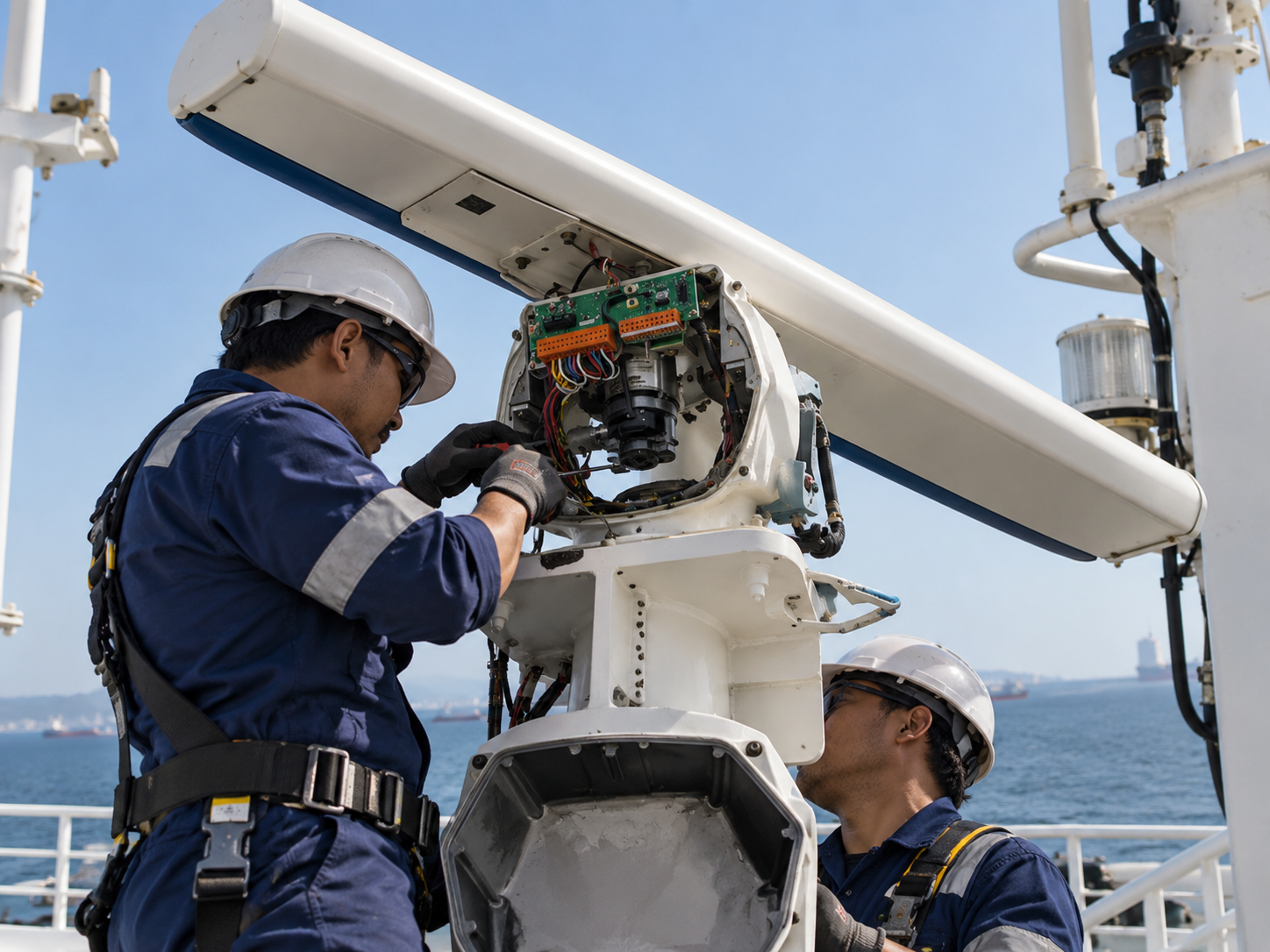

Master Systems repairs marine radars on ships at Walvis Bay, at Lüderitz and at anchor off both ports. We work on X-band and S-band navigation radars, from small sets on trawlers to dual-radar installations on tankers and bulk carriers. The aim of every radar repair in Namibia is the same: find the fault, fix it on board, and prove the radar is working before the ship sails.
Most radar failures come down to a handful of parts:
Newer solid-state radars have no magnetron, but they still have scanner, cable and processor faults, and we repair those too.
The scanner sits at the top of the mast and takes the worst of the weather. On this coast that means salt spray from the Atlantic, damp air from the cold Benguela Current, and fine sand carried offshore when the east wind blows from the Namib. Salt and damp get past tired seals into the scanner housing. Sand gets into bearings and wears the antenna’s moving parts. Fishing vessels feel this most: their radars run for long hours on every trip, and a sealing problem left until the next dry dock usually ends with a replaced scanner, not a resealed one.
Checking and replacing seals and gaskets during routine service is cheaper than repairing the damage afterwards.
Under SOLAS, every ship of 300 GT and above must carry an X-band (9 GHz) radar. Ships of 3,000 GT and above also need a second radar, normally S-band (3 GHz). X-band gives a sharper picture and detects small targets well at close range. S-band copes better with rain and sea clutter at longer range. A ship with one radar out of service has lost part of its required equipment, and that can lead to a port state control deficiency. We repair both bands and check that the two radars, the ECDIS and any shared displays are using the same heading and position data.
We repair navigation radars from the main marine makers, including JRC, Furuno, Kelvin Hughes, Sperry Marine, Raytheon Anschütz, Simrad and Koden. Older models are often still worth repairing if parts are available. For JRC, see also our JRC service in Namibia page.
When a radar is old, a repair isn’t always the cheapest choice over the next few years. Before quoting a major repair, we look at:
If replacement makes more sense, we quote a new radar and plan the installation for a port stay at Walvis Bay.
We attend ships at Walvis Bay, including commercial berths, fishing quays and ship repair yards. We also attend at Lüderitz and at the anchorages off both ports. Offshore vessels are attended through their agents. For urgent faults, our team answers 24/7.
Our radar picture is weak and long-range targets are fading. What’s wrong?
On a conventional radar, a worn magnetron is the most likely cause, but a wet waveguide or a tuning fault can look the same. The engineer tests each before replacing anything.
Can you repair the scanner without removing it from the mast?
Often, yes. Motors, slip rings, belts and seals can usually be changed in place. A badly corroded scanner may need to come down.
Our S-band radar is down but the X-band works. Can we sail?
Report the defect to your flag and class and follow their instructions. Ships that must carry two radars can be held at a port state control inspection with one out of service, so book the repair as early as you can.
Do you repair radars on fishing vessels?
Yes. We work on the smaller radars fitted to trawlers and longliners as well as on merchant ship installations.
Is radar repair in Namibia available outside working hours?
Yes. Urgent radar faults are handled 24/7.
Call +971 4 5519370 or +971 55 9931140, message us on WhatsApp at +971 55 7067698, or email info@mastersystems.com. Include the vessel name, port and ETA, the radar make and model, and the fault you’re seeing.