Master Systems works as an offshore safety contractor in Angola, inspecting and servicing safety equipment on FPSOs, drilling units and the offshore vessels that support them. We plan each job around offshore realities: limited beds on board, crew change schedules, permit-to-work systems and the need to keep production or operations running while safety equipment is serviced.
Angola has one of the largest FPSO fleets in the world. Its deepwater production began with the Girassol FPSO in Block 17 in 2001, and many units now operate far offshore in the Lower Congo and Kwanza basins. Older shallow-water fields remain active off Cabinda and near the coast. These assets are served from supply bases at Luanda, Soyo and Malongo by a large fleet of platform supply vessels, anchor handlers, crew boats and standby vessels.
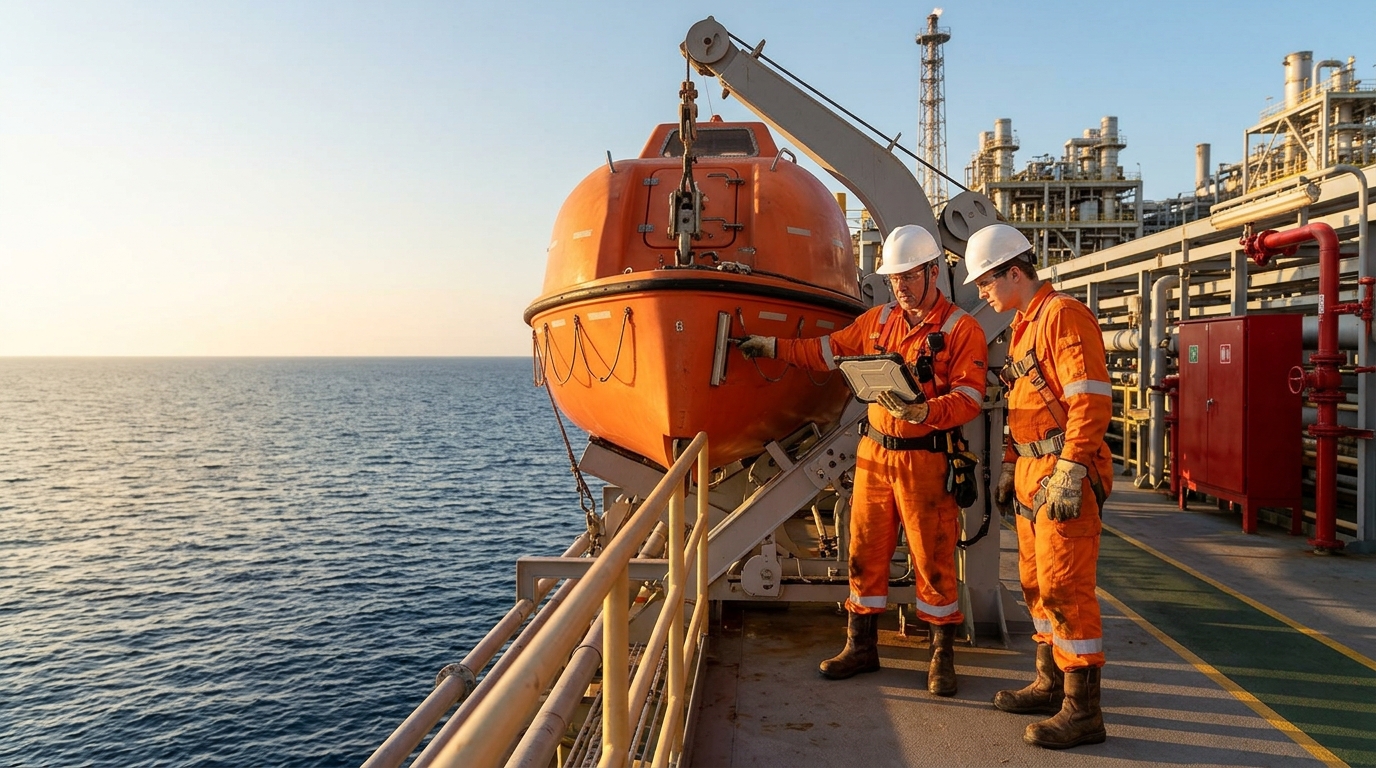
This mix creates a wide range of safety equipment needs. For example, a deepwater FPSO may carry freefall lifeboats, fast rescue craft and large fixed fire systems, while a crew boat may have only liferafts, lifejackets and portable extinguishers. Each asset also follows different rules: SOLAS for vessels, the MODU Code for drilling units, and flag, class and operator standards for production units.
Survival craft and rescue boats. We inspect lifeboats, freefall lifeboats, rescue boats and fast rescue craft, together with their davits, winches and release gear. Detailed work, such as annual and five-yearly examinations, is covered on our lifeboat inspection in Angola page.
Fire-fighting systems. We cover portable and wheeled extinguishers, fixed CO2 systems, foam and water-based systems, fire hoses and fire detection panels. For more detail, see FFA services in Angola offshore.
Breathing apparatus. We inspect SCBA sets, EEBDs and air cylinders, including hydrostatic testing coordination and breathing air quality checks.
Gas detection. We calibrate and repair portable multi-gas detectors, and test fixed gas detection systems on production units and tankers.
Personal lifesaving equipment. We inspect lifejackets, immersion suits, lifebuoys and associated lights and smoke signals.
Offshore safety work needs more planning than a port call. A typical job includes:
Before awarding offshore safety work, operators and charterers in Angola typically check:
For vessels and work in port, see our pages on marine safety services in Luanda, gyro service in Angola and radar repair in Angola. Our blog post on marine services in Angola gives a wider overview of the market.
Can you carry out safety servicing on an FPSO without stopping production?
In most cases, yes. Work is planned under the installation’s permit-to-work system, with systems isolated and tested one at a time so production can continue.
How do your technicians reach offshore installations?
Usually by helicopter for deepwater FPSOs and rigs, and by crew boat for nearer assets. Travel is arranged with the operator’s logistics team.
Can several safety jobs be combined in one offshore trip?
Yes. Combining LSA, FFA, breathing apparatus and gas detection work on one trip reduces POB pressure and travel costs.
What rules apply to offshore safety equipment in Angola?
It depends on the asset. Vessels follow SOLAS, drilling units the MODU Code, and production units follow flag and class rules. Operators often add their own standards on top.
Do you service safety equipment on Angolan-flag vessels?
Yes. We support both Angolan-flag and foreign-flag vessels working in Angolan waters.
If your FPSO, rig or offshore vessel in Angola has safety equipment due for service, contact us with the asset name, location, equipment list and preferred dates. Our team will help plan the scope, POB and logistics.