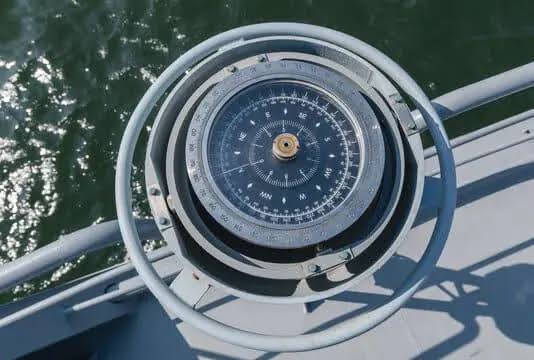
Gyrocompass support for LNG carriers, container ships and offshore vessels, from our office in Doha
Ships calling at Qatar tend to fall into three groups: LNG carriers loading at Ras Laffan, container and general cargo ships at Hamad Port, and tankers and offshore support vessels working out of Mesaieed. Each of them relies on the gyrocompass in a different way, and each has a different amount of time to spare when it goes wrong. Our gyro service in Qatar is set up around those differences.
Master Systems has an office at Barwa Village in Doha, on the southern side of the city and a short drive from Hamad Port and Mesaieed. Ras Laffan is further north, so for terminal work we plan the trip and the gate pass with the ship’s agent in advance. Master Systems has serviced marine navigation and communication equipment since 1999, and the Qatar team is supported by our regional offices in the UAE, Bahrain and Saudi Arabia when a job needs extra hands or parts.
The vessels we support in Qatar, and what each needs
Vessel type
What usually matters most
LNG carriers
Short terminal windows, dual-gyro systems, newbuild warranty and commissioning issues
Container and cargo ships
Quick turnaround alongside, repeater and interface faults
Tankers
Annual service timed around loading, heading accuracy for berthing
Offshore and DP vessels
Redundant heading references for the DP system, fast repair to stay on charter
LNG carriers at Ras Laffan
Qatar’s LNG fleet is growing quickly. QatarEnergy’s shipbuilding programme now covers well over 100 new carriers, many of them being delivered through 2026 and beyond. New ships bring their own gyro work: commissioning checks, faults found in the first months of service, and interface settings that were never fully finished at the yard. Most LNG carriers also run two gyrocompasses with a changeover unit, so we check both systems, the switch-over and every heading output, not just the master compass that is showing the alarm.
Offshore and DP vessels
On a dynamically positioned vessel, the gyro is more than a navigation instrument. It is one of the heading references the DP system uses to hold position. DP class 2 and class 3 vessels normally carry three heading references under class rules. If one fails or drifts, the vessel may lose its DP class notation for the work it is doing, so these jobs are treated as urgent. We check each gyro against the others, confirm that the DP system reads every one of them correctly, and record the result for the vessel’s DP trials and annual checks.
Gyrocompass makes we work on
Our engineers service traditional spinning-mass gyrocompasses and fibre-optic gyros from:
Anschütz, including Standard 22 and Standard 30 systems
Sperry Marine (Navigat series)
Tokyo Keiki (TG series)
Yokogawa / YDK Technologies (CMZ series)
Simrad (GC series)
NSR (NGC series, including fibre-optic models)
We also service GNSS satellite compasses, such as Furuno’s SC series. It’s worth knowing which of these your ship has, because a satellite compass depends on GPS and a gyrocompass does not.
Gyro checks that matter during GNSS interference in the Gulf
Throughout 2026, ships in the Arabian Gulf and the approaches to the Strait of Hormuz have reported widespread GPS jamming and spoofing. Officers have been advised to cross-check positions with radar and visual bearings. A healthy gyrocompass is one of the few bridge instruments that keeps working when GNSS doesn’t, but only if the rest of the system is set up for it.
On ships trading to Qatar, we now check:
The speed input. If the gyro takes its speed correction from GPS, and GPS is spoofed, the heading error grows. We check whether a speed log can be used instead, and how the switch is made.
Heading sources. Which instruments get their heading from the gyro, and which get it from a satellite compass. During interference, the crew needs to know which displays are still independent of GPS.
Gyro alarms and comparison. Whether the heading monitoring alarms on ECDIS and radar are set correctly, so a drifting gyro is spotted early.
Can you attend an LNG carrier at Ras Laffan during its loading window?
Yes, provided the agent arranges the gate pass and the terminal allows the work. Most annual gyro services and many repairs can be done within a normal loading call. Send us the ETB and the expected loading time when you book.
One of our three DP gyros is drifting. Can the vessel keep working?
That depends on your DP class and the vessel’s operations manual, and it is a decision for the master and DP operators. What we can do is attend quickly, find out whether the gyro, its interface or the DP input is at fault, and restore the third reference as soon as possible.
Does GPS jamming affect our gyrocompass?
A gyrocompass finds north on its own, so it keeps working without GPS. However, if its speed correction comes from GPS, a false speed input can add heading error. A satellite compass, in contrast, depends fully on GNSS. We can check how your ship is set up.
Our newbuild gyro has a fault while still under warranty. Can you help?
Yes. We can attend, diagnose the fault and send a report to the manufacturer or shipyard, so the warranty claim can be handled correctly. [Client to confirm how warranty work is handled with OEMs.]
How often should a gyrocompass be serviced?
Most owners book a gyro service once a year, in line with the manufacturer’s recommendation and the vessel’s planned maintenance system. Fibre-optic gyros need less mechanical work, but their outputs and alignment should still be checked. Our article Magnetic vs Gyrocompass: Which Needs More Frequent Calibration at Sea? explains the difference in more detail.
Contact our Qatar office
Master Systems – Qatar Barwa Village, Building B-16, Office 14 & 15, Doha, Qatar Email: qatar@mastersystems.com Phone: +974 4476 3755 | Mobile: +974 7070 7200