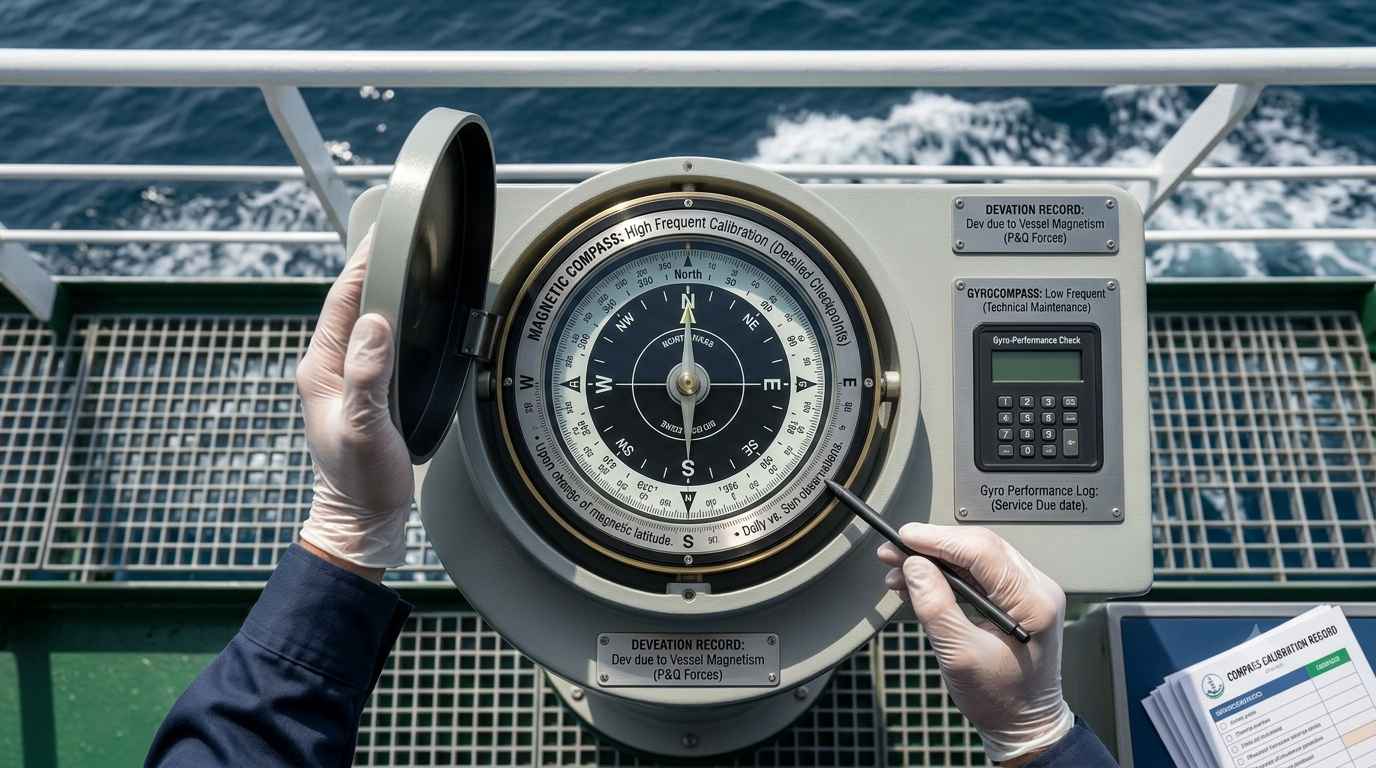
Magnetic vs Gyrocompass: Which Needs More Frequent Calibration at Sea?
Every vessel on the water relies on at least two compasses, a magnetic compass and a gyrocompass, and both demand attention to stay accurate. But they fail in different ways, drift for different reasons, and are governed by different regulatory timelines. For ship masters, navigation officers, and vessel operators, knowing which one needs more frequent calibration isn’t just a compliance question. It’s a safety one.
How They Work — and Why That Determines Calibration Needs
Before comparing calibration schedules, it helps to understand what makes each compass drift in the first place.
A magnetic compass is a passive instrument. It has no power supply and aligns itself with the Earth’s magnetic field. Its enemy is deviation, the distortion caused by the vessel’s own magnetic field from steel structures, electrical equipment, and onboard machinery. Every time something changes on the ship (new cargo, structural repairs, relocated equipment), the compass’s deviation can shift.
A gyrocompass, by contrast, finds true north by detecting the Earth’s rotation using a rapidly spinning gyroscope. It needs electrical power to operate and is affected by speed error and latitude errors, systematic inaccuracies that increase at higher latitudes and faster vessel speeds. Its internal components, gyro spheres, liquid, and bearings wear down over time.
This fundamental difference explains why their calibration profiles look so different.
Magnetic Compass: More Frequent Monitoring, More Triggers
The magnetic compass is the higher-maintenance instrument when it comes to calibration frequency, not because its formal adjustment interval is shorter, but because it has far more triggers that can force an unscheduled recalibration.
Regulatory baseline
ISO 25862:2019 (the current international standard for magnetic compasses) requires that magnetic compasses be swung and adjusted at least every two years, as well as after dry docking and following any significant structural work.
SOLAS V Annex 13 further specifies that an adjustment is required when: the compass is first installed; it becomes unreliable; following structural repairs; electrical equipment near the compass is added or removed; or two years have elapsed since the last adjustment.
Some port authorities and flag states go further. The Panama Canal, for instance, requires vessels of 150 gross tons and over to renew their deviation table annually, with residual deviation verified by a recognised calibration authority within the previous 12-month period.
Daily monitoring obligations
Beyond formal adjustment, the magnetic compass requires active daily monitoring. IMO Resolution A.382(X) recommends that compass deviations be recorded in a compass deviation book at regular intervals, ideally at least once every watch and shortly after a large alteration of course.
If observations show a deviation of more than 5 degrees on any heading, the compass must be adjusted by a qualified compass adjuster or the master of the vessel.
Event-driven triggers
Beyond the scheduled 2-year cycle, masters are advised to check compass performance, particularly when carrying cargoes with magnetic properties, using electromagnetic lifting appliances to load or discharge, after any casualty involving severe contact or electrical discharge; or after the ship has been laid up, even a short period of idleness can lead to serious deviations, especially for smaller vessels.
Deviation can also change when ships travel to different latitudes or when cargo is rearranged. Marine Public. This makes the magnetic compass uniquely sensitive to operational factors, not just the passage of time.
Gyrocompass: Less Frequent Formal Calibration, but Demanding Maintenance
The gyrocompass has a more predictable maintenance profile, but its servicing is more technically complex, and the consequences of neglect are more catastrophic because most vessel systems (ECDIS, autopilot, ARPA radar) feed from the gyrocompass.
Regulatory baseline
Under SOLAS CH V Regulation 19.2.5.1, all ships of 500 gross tonnage and upwards are required to carry a gyrocompass that can determine and display heading by non-magnetic means, clearly readable by the helmsman at the main steering position. Ozelmarine
Unlike the magnetic compass, the gyrocompass is not subject to a fixed 2-year recalibration mandate under IMO regulations. Its maintenance is governed by manufacturer (OEM) guidelines and class society requirements.
Maintenance timeline
Liquid in gyro spheres typically needs to be replaced annually, while the gyro spheres themselves may need replacement every 5 years. Learnmarine
Annual maintenance is considered essential to ensure continued accuracy and safe operation, covering inspections of all components, cleaning, lubrication, checks of electrical connections and cooling systems, and diagnostic tests. The sensitive element is generally recommended for replacement every 4 years as per OEM guidelines. Ftron
Error characteristics
The gyrocompass also has inherent systematic errors that officers must account for daily. Significant errors of a random nature can arise in gyrocompasses in the absence of speed and latitude corrections. Learnmarine: These errors must be manually applied and monitored on every watch, similar to the daily deviation checks required for the magnetic compass.
Head-to-Head: Calibration Comparison
FACTOR
MAGNETIC COMPASS
GYROCOMPASS
Formal adjustment interval
Every two years(ISO 25862)
Annual service; sphere replacement every 4-5 years
Daily monitoring required
Yes – every watch
Yes- error checks on every watch
Event-based triggers
Many (cargo, repairs, dry dock, latitude change)
Few (mainly com[lonent wear or power interruptions)
Calibrated by
Certified compass adjuster
OEM technician/ service engineer
Regulatory document
SOLAS V / ISO 25862 / IMO A. 382(X)
SOLAS V Reg. 19 / IMO A.821(19) / OEM PMS
Consequence of drift
Navigational error(backup instrument)
Cascading failure across ECDIS, autopilot, and radar
Which Needs More Frequent Calibration?
The magnetic compass needs more frequent calibration attention overall, not because its formal adjustment schedule is shorter than the gyrocompass’s major overhaul cycle, but because it is exposed to far more drift triggers and demands active daily monitoring throughout every voyage.
The gyrocompass, while requiring annual servicing and component replacement on a multi-year cycle, has a more controlled and predictable maintenance schedule. Its risks are lower under normal operations, but the stakes are higher when it fails, precisely because so many critical navigation systems depend on it.
For vessel operators, the practical takeaway is this: treat magnetic compass calibration as an ongoing, voyage-sensitive process and treat gyrocompass maintenance as a scheduled technical overhaul that should never be delayed or deferred.
When Must Both Be Recalibrated Together?
There are specific events that trigger the recalibration of both instruments simultaneously.
After dry docking or major structural repair
Following the installation or removal of significant electrical equipment near the bridge.
After a serious grounding or collision.
When either instrument shows persistent error trends that cannot be corrected by normal adjustment.
Conclusion
Both the magnetic compass and the gyrocompass are mandatory under SOLAS for most commercial vessels, and both require disciplined calibration regimes. The magnetic compass demands more frequent formal recalibration cycles and continuous watch-by-watch monitoring. The gyrocompass requires annual technical servicing with longer component replacement intervals, but its systematic errors must still be checked every watch.
Understanding the difference isn’t just academic. Port State Control inspectors check both deviation records and inaccurate compasses, which have been cited in incident reports that have cost vessels their certificates. Staying ahead of the calibration schedule for both instruments is the baseline of safe navigation.