Gyrocompass repair, annual service and calibration, run from our office in Suez
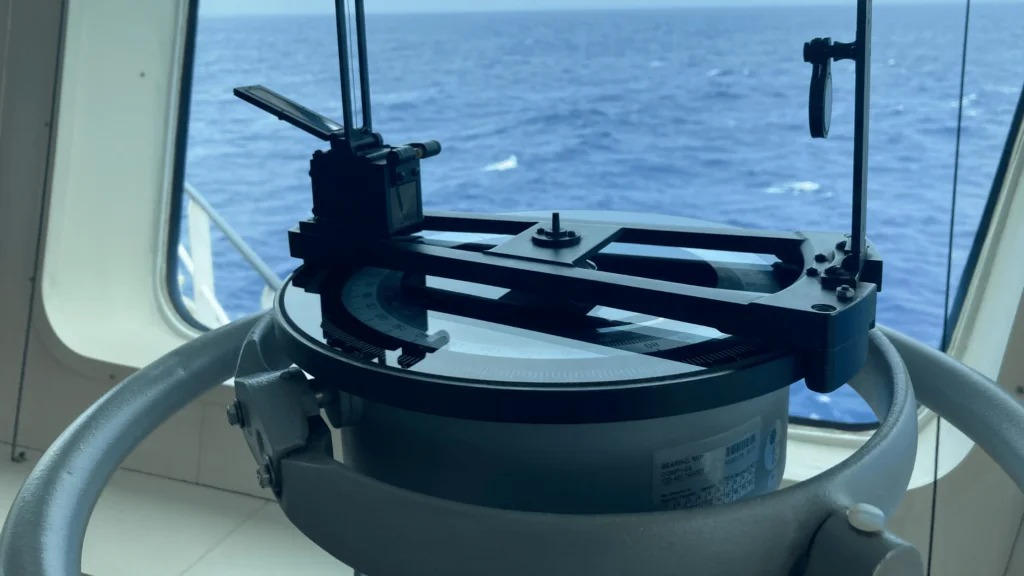
A ship’s gyrocompass feeds heading to almost everything on the bridge: the radar, ECDIS, autopilot, AIS and VDR. When it drifts or stops settling, the whole navigation picture is affected. That is why our gyro service in Egypt is run from a local base rather than flown in. Master Systems has an office at Port Tawfiq in the Suez Free Zone, so our engineers can reach vessels at the southern end of the Suez Canal, in Suez Bay anchorage and at Red Sea terminals quickly, and can travel on to the Mediterranean ports when a ship is calling there instead.
We have worked on marine navigation and communication equipment since 1999, and Egypt is one of 24 Master Systems locations. In practice, that means the engineer who attends your vessel has backup: spare parts, technical support and, where needed, a second engineer from our wider network.
What our gyro service in Egypt covers
Most requests we receive fall into one of four categories:
- Annual gyro service. A planned check of the master compass, control unit, repeaters and outputs, with a signed service report for your records, class surveys and Port State Control.
- Breakdown repair. Gyros that will not settle, show a heading alarm, wander off a known bearing or lose their output to other bridge equipment.
- Calibration and error correction. Comparison against a known reference, correction of fixed error, and a check of speed and latitude correction settings.
- Installation, replacement and retrofit. New or replacement gyrocompass systems, including repeaters, changeover units and interfacing with existing radar, ECDIS and autopilot.
In addition, we supply spare parts such as gyrospheres, supporting fluid, PCBs, repeaters and power units. Where a part is not held locally, we arrange delivery so it meets the ship in port or at anchor.
Gyrocompasses we service
Our engineers work regularly on the main marine gyro brands, including:
- Anschütz (formerly Raytheon Anschütz), including the Standard 22 series
- Sperry Marine (Navigat series)
- Tokyo Keiki (TG series)
- Yokogawa / YDK Technologies (CMZ series)
- Simrad (GC series)
- NSR (NGC series, including fibre-optic models)
Master Systems was named NSR Marine’s Gold Partner of the Year for 2024–2025. If your vessel has a model not listed here, send us the make and model; we will tell you honestly whether we can support it.
How a gyro attendance works
- Send us the details. Vessel name, IMO number, ETA, port or anchorage, gyro make and model, and a short description of the fault or the service required. Photos of any alarm or error code help a lot.
- We check parts before we sail out. Based on the fault, the engineer brings the likely spares, so a second trip is not needed.
- Onboard diagnosis. The engineer checks the master compass, power supply, settling behaviour, heading against a known reference, repeater alignment and the heading output to connected equipment.
- Repair or service. Faults are fixed on board where possible. If a unit needs workshop repair, we explain the options, including a loan or exchange unit where available, before any work starts.
- Report. You receive a service report listing the checks carried out, readings, parts used and any recommendations. Keep it with the ship’s records for class and Port State Control.
Common gyro faults on ships calling Egypt
The same handful of problems account for most of our breakdown calls:
- Gyro will not settle, or takes far longer than normal after start-up. On spinning-mass gyros, this often points to an ageing gyrosphere or degraded supporting fluid.
- Heading error that changes with speed or latitude, usually caused by incorrect speed or latitude input, or a failed log feed.
- Repeaters out of step with the master compass after a power interruption.
- ECDIS, radar or autopilot showing heading alarms while the gyro itself looks normal. Here, the problem is often in the interface, wiring or output configuration rather than the gyro.
- Fan, heater or power supply failures in the control unit, especially on older systems in hot engine-room-adjacent spaces.
If you are deciding whether an older gyro is worth repairing, our article on refurbishing the Anschütz Standard 22 and our guide to the benefits of upgrading to a digital gyrocompass set out the trade-offs.
Compliance: why the annual gyro service matters
Under SOLAS Chapter V, Regulation 19, ships of 500 gross tonnage and above must carry a gyrocompass, together with gyro repeaters for the emergency steering position and for taking bearings. Because the same heading signal feeds radar, ECDIS, AIS and the VDR, a faulty gyro can lead to several deficiencies at once during a Port State Control inspection.
A documented annual gyro service is therefore the simplest protection. It shows the equipment has been checked, records any fixed error, and gives the officers a baseline to compare against at sea. For a closer look at how often each type of compass should be checked, see Magnetic vs Gyrocompass: Which Needs More Frequent Calibration at Sea?
Other services we can combine with your gyro attendance
While a ship is in Egypt, it often makes sense to group navigation work into one boarding. Our Suez team can also handle:
For background on how the gyro connects to the rest of the bridge, read Integration of Gyro Compass with Navigation Systems.
Frequently asked questions
- How quickly can you attend a vessel in Egypt?
It depends on the port and the time of day. Suez and Suez Bay anchorage are closest to our office, so these are usually the quickest. For Port Said, Alexandria, and Damietta, the engineer travels by road. Send us your ETA as early as possible, and we will confirm timing.
- Can the gyro service be done while we wait for a Suez Canal convoy?
Often, yes. An annual gyro service or a straightforward repair can usually be completed during the anchorage wait, provided we know the vessel’s ETA and the agent arranges the launch in advance.
- How long does an annual gyro service take?
A routine annual service typically takes a few hours on board. Breakdown repairs vary, because a spinning-mass gyro may need several hours to settle after a component change before the heading can be verified.
- Do you provide a service report for class and Port State Control?
Yes. Every attendance ends with a written service report covering the checks carried out, readings taken, parts replaced and any recommendations.
- Do you supply gyro spare parts in Egypt?
Yes. We supply gyrospheres, supporting fluid, PCBs, repeaters and other parts for the main brands. Where an item is not in stock locally, we arrange delivery to the vessel.
- Do you service fibre-optic gyrocompasses?
Yes. Fibre-optic gyros have no spinning parts, so they need less routine maintenance, but their interfaces, power supply and alignment still need checking. Read more in our article on NSR’s fibre-optic gyrocompass series.
Contact our Egypt office
Master Systems – Egypt Port Tawfiq, Suez Free Zone, Suez, Egypt Email: egypt@mastersystems.com Phone: +20 106 1806201 | Mobile: +20 127779 8675
To book a gyro service in Egypt, send an enquiry with your vessel details and ETA, or find your local contact.