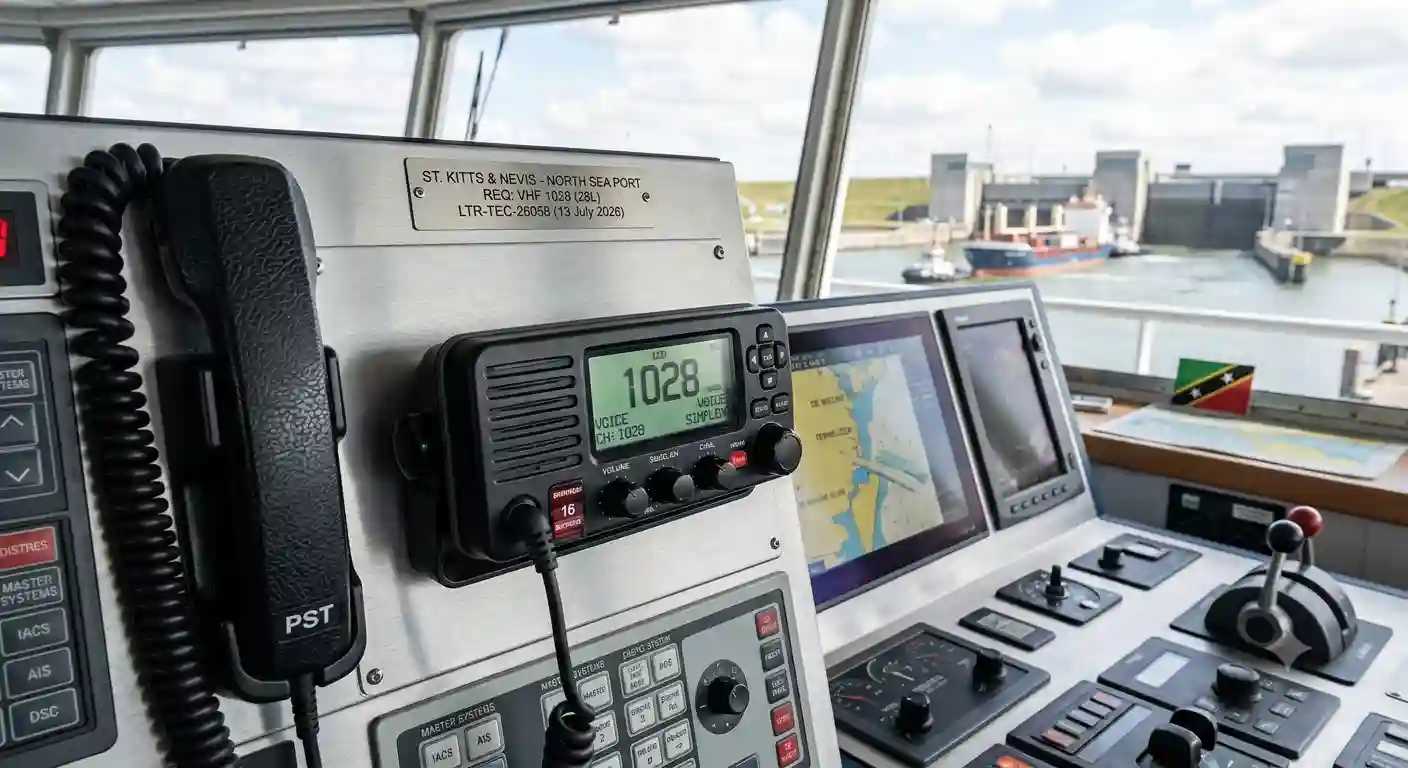
If your vessels call at the North Sea Locks in Terneuzen, there’s a VHF programming requirement you need to have sorted before transiting the new lock, De Nieuwe Sluis.
Rijkswaterstaat, the Joint Nautical Authority, and North Sea Port have confirmed that once De Nieuwe Sluis comes into operation, all VHF communication between the lock operator, pilot, vessel, boatmen, and tugboats takes place on VHF voice channel 1028 (28L). If your onboard VHF radio isn’t programmed for it, you won’t be allowed to enter.
VHF voice channel 1028 is a simplex channel defined under Appendix 18 of the ITU Radio Regulations. It was introduced following the removal of NBDP (Narrow Band Direct Printing) from GMDSS and the rollout of VDES, the VHF Data Exchange System.
The change traces back to IMO MSC.1/Circ.1460/Rev.4, approved at the Maritime Safety Committee’s 107th session in 2023, which set out guidance on the validity of radiocommunications equipment on ships. The Netherlands and Belgium had already begun implementing the updated Appendix 18 regulations and ECC decision (19)03. Given how VHF voice channels are currently used in the Scheldt area, channel 1028 (28L) was identified as the only workable option for the North Sea Locks, a point confirmed in IMO Circular Letter No. 4791.
Ships approaching De Nieuwe Sluis for transit still follow the standard reporting regime already in place. The difference is that channel 1028 (28L) is now the channel used to report and communicate through the entire process, entrance, locking, and departure, keeping the lock master, ship, tugs, and boatmen in continuous contact.
Note that this guidance applies specifically to the INT (international) and BI (Inland Waters) channel plans in your VHF voice radio.
VHF channels 27 and 28 (duplex) These can no longer be used in duplex mode for spoken communication within the EU. Depending on your radio’s display:
Vessels can keep the old duplex 27/28 programmed for use outside Europe, but only until 1 January 2028.
VHF channels 24, 25, 26, 84, 85, and 86 These are no longer usable for spoken communication within Europe and are now reserved for VDES data transmission. They can still be used for voice outside the EU, but only until 1 January 2030 if left programmed as such.
The advisory also flags a few recurring issues seen on vessels calling at the locks:
None of these are new requirements, but they’re common enough that it’s worth a full check rather than just updating for channel 1028.
This is exactly the kind of check that falls under Radio Survey work. If your VHF voice radios haven’t been verified against the current Appendix 18 channel plan, or you’re not sure whether your fleet is compliant for the Scheldt area, our team can inspect and reprogram your equipment as part of a Radio Communication Equipment survey.
Getting this wrong doesn’t just risk delays at the lock. Under the current guidance, vessels without the correct VHF voice channels for the Scheldt area will not be permitted to enter the working area of the Joint Nautical Authority before reaching De Nieuwe Sluis.
If you have vessels regularly transiting Terneuzen, or you simply want your VHF equipment checked against the latest Appendix 18 regulations, reach out to Master Systems to arrange an inspection.