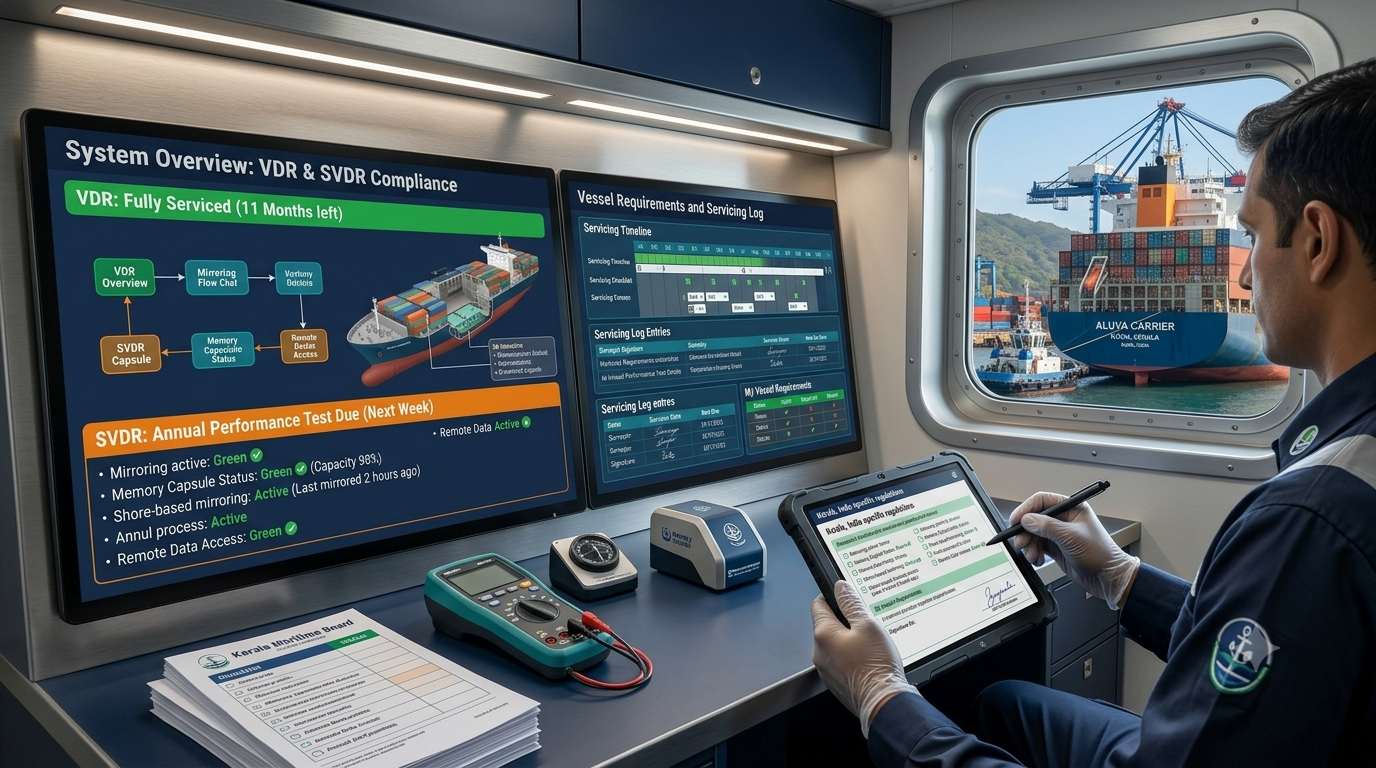
Data recorders for vessels’ voyages have become extremely significant in the modern shipping industry with respect to ship safety, investigation of accidents and incidents, and compliance issues. In particular, there exist two widely applied data recorder machines, including Voyage Data Recorder and Simplified Voyage Data Recorder. Even though these two share similar functioning processes, there is a marked distinction in their application and upkeep.
A Voyage Data Recorder (VDR) is known as the marine equivalent of a plane’s “black box,” recording essential navigational data for the ship. The data collected by a VDR includes:
The purpose of a VDR is to assist in accident investigations, improve safety management, and provide valuable data during maritime incidents.
A Simplified Voyage Data Recorder (SVDR) performs a similar function but records a reduced set of essential data compared to a full VDR system.
SVDRs were introduced primarily for older cargo vessels where integrating a complete VDR system could be technically difficult or economically impractical. Unlike a full VDR, an SVDR may not record all radar or audio inputs continuously.
In simple terms:
| Feature | VDR | SVDR |
| Data Collection | Comprehensive | Limited/Simplified |
| Radar Recording | Mandatory | Limited capability |
| Audio Recording | Full bridge audio | Reduced inputs |
| Installation Complexity | Higher | Lower |
| Typical Vessel Type | Passenger ships & newer cargo ships | Older cargo ships |
The application of VDR or SVDR is governed by the IMO’s SOLAS Chapter V Regulation 20 according to ship type, ship size, and build date.
The following vessels generally require a full VDR:
These vessels must maintain fully operational VDR systems at all times during voyages.
Certain older cargo vessels may carry an SVDR instead of a full VDR:
However, many older ships are now being upgraded to full VDR systems during retrofits or modernization projects.
A full VDR records extensive operational data from multiple onboard systems, whereas an SVDR focuses only on essential information.
Both systems contain protective storage capsules designed to survive marine casualties, but VDRs typically offer more advanced data preservation features.
VDR systems require integration with several bridge systems, such as:
SVDR integration is less extensive.
Modern VDRs comply with updated IMO performance standards, while some older SVDR systems may require upgrades to remain compliant.
One of the most important compliance requirements is the Annual Performance Test (APT).
Annual Performance Test (APT)(h3)
According to IMO and SOLAS regulations:
After successful testing, the vessel receives an official certificate confirming compliance.
Failure to complete annual testing can lead to:
A certified technician typically performs the following checks:
VDR and SVDR servicing should only be performed by technicians authorized by the equipment manufacturer or approved classification societies.
When selecting a service provider, vessel operators should ensure:
Certified servicing helps maintain warranty validity and ensures compliance during inspections.
Apart from annual testing, vessel operators should monitor systems regularly for:
Ignoring these issues can result in non-compliance or data loss during critical incidents.
Many shipping companies are now upgrading older SVDR systems to modern VDR units because of:
Upgrading can also reduce long-term maintenance challenges associated with obsolete SVDR equipment.
Both VDR and SVDR systems are essential tools for maritime safety and regulatory compliance. Understanding which system your vessel requires under SOLAS regulations is critical for avoiding deficiencies and ensuring operational readiness.
While VDR systems provide more comprehensive recording capabilities, SVDR units still play an important role for certain older cargo vessels. Regardless of the system installed, annual performance testing by certified service providers is mandatory and should never be overlooked.
As maritime regulations continue to evolve, proactive maintenance, timely servicing, and system upgrades remain the best strategy for ensuring compliance and protecting vessel operations at sea