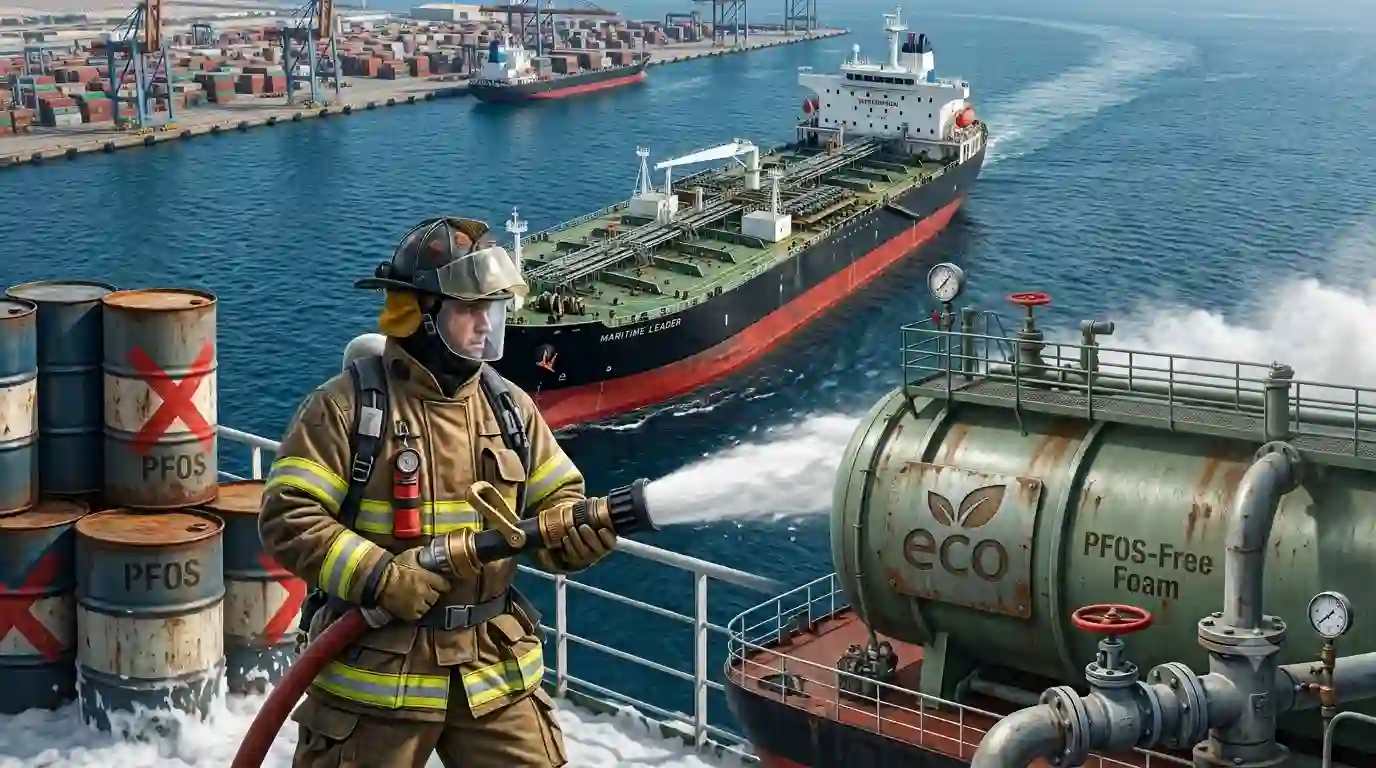

PFOS Ban in Firefighting Foam: What Ship Owners Need to Know Before 1 January 2026

WaveIcon

Firefighting foam is changing across the maritime industry, and the deadline is closer than most fleets realise. From 1 January 2026, new amendments to SOLAS Chapter II-2 – together with the 1994 and 2000 High-Speed Craft (HSC) Codes – prohibit the use or storage of fire-extinguishing media containing perfluorooctane sulfonic acid (PFOS) on board vessels. For owners, managers, and operators across West Africa, the Middle East, and beyond, this is a compliance milestone that touches fixed systems, portable equipment, and every certificate tied to them.

At Digital Marine Systems, we work with ship owners and managers across our service network – from Tema and Lagos to Luanda and Dubai to make this transition straightforward. Here’s what the regulation actually requires, and how to stay ahead of it.

What Is PFOS, and Why Is It Being Banned?

PFOS belongs to a family of man-made chemicals known as PFAS (per- and polyfluoroalkyl substances), often called “forever chemicals” because they resist breaking down in the environment and the human body. PFOS has been in use as an essential component of fire-fighting foam due to its impressive properties of wetting, reseaching oil and water. However, it has now become a danger to human health and the marine environment, and, thus, it is being phased out by the IMO in the maritime fire-fighting practice.

The New Regulatory Requirement

The IMO has adopted amendments – MSC.532(107) for SOLAS Chapter II-2, and MSC.536(107) / MSC.537(107) for the HSC Codes – that introduce a clear prohibition:

  • What’s banned: Fire-extinguishing media (including all firefighting foams on board) containing PFOS above 10 mg/kg (0.001% by weight).
  • Where it applies: Both fixed fire-extinguishing systems and portable firefighting equipment.
  • Effective date: 1 January 2026.

For New buildings

Any vessel with a keel-laying date on or after 1 January 2026 must not be delivered with firefighting foam exceeding the PFOS threshold.

For Vessels Already in Operation

All existing ships are required to prove compliance by their initial survey, which is set to take place on or after January 1, 2026, meaning the first annual, regular, or renewal survey that they will go through in relation to the Cargo Ship Safety Equipment Certificate, the Cargo Ship Safety Certificate, the Passenger Ship Safety Certificate, or the High-Speed Craft Safety Certificate. Additionally, flag states can declare that they will impose compliance on other ships in addition to these vessels.

How Compliance Is Verified

This isn’t a self-declaration exercise. Classification societies will expect one of the following before issuing sign-off:

  • Manufacturer’s declaration or laboratory test report confirming the foam is PFOS-free, including foam type, production period, batch number, and reference to its Type Approval / MED Certificate.
  • On-board sampling and testing against a recognised standard (such as NPR-CEN/TS 15968) for any extinguishing media installed before 1 January 2026, where manufacturer documentation isn’t available.

If your vessel’s foam records are incomplete, patchy, or simply undocumented – which is common on older tonnage, testing becomes the only route to a defensible compliance position.

Replacing Non-Compliant Foam: What to Get Right

Swapping out foam isn’t as simple as refilling the tank with a new product off the shelf. To avoid downstream problems with your fixed system, the replacement foam must match the original on several fronts:

  • Same mixing ratio (e.g. 1%, 3%, or 6%)
  • Similar viscosity, or your foam pumps and mixing unit may need adjustment
  • Equivalent approval type (regular, alcohol-resistant, or multi-purpose)
  • Type approval in line with IMO requirements – MSC/Circ.670 for high-expansion foam, MSC.1/Circ.1312 Corr.1 for low-expansion foam
  • A TA/MED Certificate that explicitly confirms the absence of PFOS

Vessels fitted with an inside air foam system face an extra layer of restriction under MSC.1/Circ.1271: only the exact foam brand, type, and mixing rate listed on that system’s TA/MED Certificate can be used as a replacement. Once the old foam is removed, it must be disposed of through an appropriate shore-based reception facility, with the removal and delivery properly logged in the ship’s official logbook.

Beyond PFOS: What’s Coming Next

It’s worth noting that this amendment only bans PFOS specifically – not the entire PFAS family. Regulators, including the EU, are already working on restrictions for other PFAS compounds such as PFOA, which could affect foam availability at EU ports. A similar move is being discussed at the IMO level, with a possible implementation target as far out as 2032. Owners who future-proof their foam transition now, rather than treating this as a one-off fix, will be better positioned for whatever follows.

How Digital Marine Systems Supports Your PFOS Transition

Meeting this deadline means acting before your next survey, not after. Our team supports vessels calling at ports across West Africa, the Middle East, and East Africa with:

  • Foam transition strategy – planning replacement around your survey schedule and system specifications
  • Existing foam testing for PFOS/PFAS – laboratory-standard sampling where manufacturer documentation is missing
  • Safe, compliant disposal of PFOS-containing foam through approved shore reception facilities
  • Compliance documentation aligned to class society and charterer requirements, ready for your first survey after 1 January 2026

If your fleet hasn’t yet confirmed which vessels are affected, the safest first step is a foam audit – before the survey clock runs out.

Need support for your PFOS transition. Contact our team to discuss vessel schedules, vendor registration, or a service partnership.